
Beginner Golf Etiquette: 12 Unwritten Rules Explained Simply

Beginner golf etiquette comes down to three things: stay safe, keep up, and look after the course. Be still and quiet when others are hitting, don't hold up the groups around you, and leave the course as you found it. The rest is detail, and this guide covers the 12 unwritten rules in plain English.
If you're nervous about your first round, you're in good company. Nobody expects a beginner to know everything. Playing partners notice effort and awareness far more than skill, and most experienced golfers are happy to explain things if you ask.
Before you tee off
1. Arrive early and warm up
Aim to arrive at least 20 minutes before your tee time, according to Columbia Association's beginner guide. That gives you time to check in, hit a few balls on the range and have a practice putt.
For the warm-up itself, the PGA suggests starting with short irons, moving up through the longer clubs, and finishing with a few soft wedge shots.
Your tee time is the slot booked for your group to start. Be on the first tee, ready, a few minutes before it.
2. Check the dress code
Dress codes vary from course to course. Some are relaxed, and others restrict things like jeans and t-shirts, as TGW's course etiquette guide notes.
The simple fix: look at the club's website or ring the pro shop before you go. Collared shirt, smart shorts or trousers and flat, comfortable shoes will be fine almost everywhere.
While others are hitting
3. Stay still and quiet
When someone is addressing the ball (getting set up to hit), stop talking and stop moving. Golf.com's beginner rules put it plainly: don't move, talk, whistle or jangle change while they're hitting. Silence your phone too.
You don't need to freeze like a statue. Just stand calmly, wait for the ball to leave, then carry on chatting.
4. Stand in the right place
Stay out of the hitter's eyeline and well away from the swing. A good spot is a few steps to the side, roughly level with the ball or slightly behind it. Never stand directly behind the player, or ahead of them.
Many beginners worry about this one, and it's easy to fix. If you're unsure, take a few extra steps back. It's much safer to be too far away than too close.
5. Know who plays first
The player who is furthest from the hole usually hits first. On the first tee, groups often decide the order casually, such as drawing tees or simply asking who'd like to go.
The right to hit first is called the honour. After the first hole, it goes to whoever scored lowest on the previous hole. If you're not sure whose turn it is, ask. "Am I up?" is a perfectly normal question.
6. Shout "Fore" if a shot goes astray
If your ball is heading towards other people, shout "Fore!" as loudly as you can. It's the standard warning in golf. Nobody will be annoyed that you shouted. People will be upset if you stayed silent.
If you hear someone else shout "Fore", don't look round. Turn away, cover your head with your arms and get low.
Keeping the pace
7. Play ready golf
Strict turn-taking can slow a round right down. In casual play, many groups use ready golf: if you're ready and it's safe to hit, go, even if you're not technically furthest away.
A few habits that help:
- Plan your next shot while others are hitting.
- Take a practice swing or two, not six.
- Park your bag or trolley on the side of the green closest to the next tee.
- If a hole is going badly, pick your ball up. In a casual round, nobody needs you to finish a 12.
8. Let faster groups through
If you've lost a ball and your search is holding people up, wave the group behind through. The same goes if you've fallen a full hole behind the group ahead and the group behind is catching you up.
It's not a judgement on your game. It's simply good manners, and almost everyone will say thank you.
Looking after the course
9. Fix your divots and pitch marks

A divot is the chunk of turf you sometimes take out with your club. Replace it and press it down with your foot. If the course provides sand-and-seed mix, fill the hole with that instead.
A pitch mark is the dent your ball makes when it lands on the green. Repair it with a pitch-mark repairer (or a tee) by gently pushing the edges in towards the centre, then tapping the surface flat with your putter.
10. Rake the bunkers
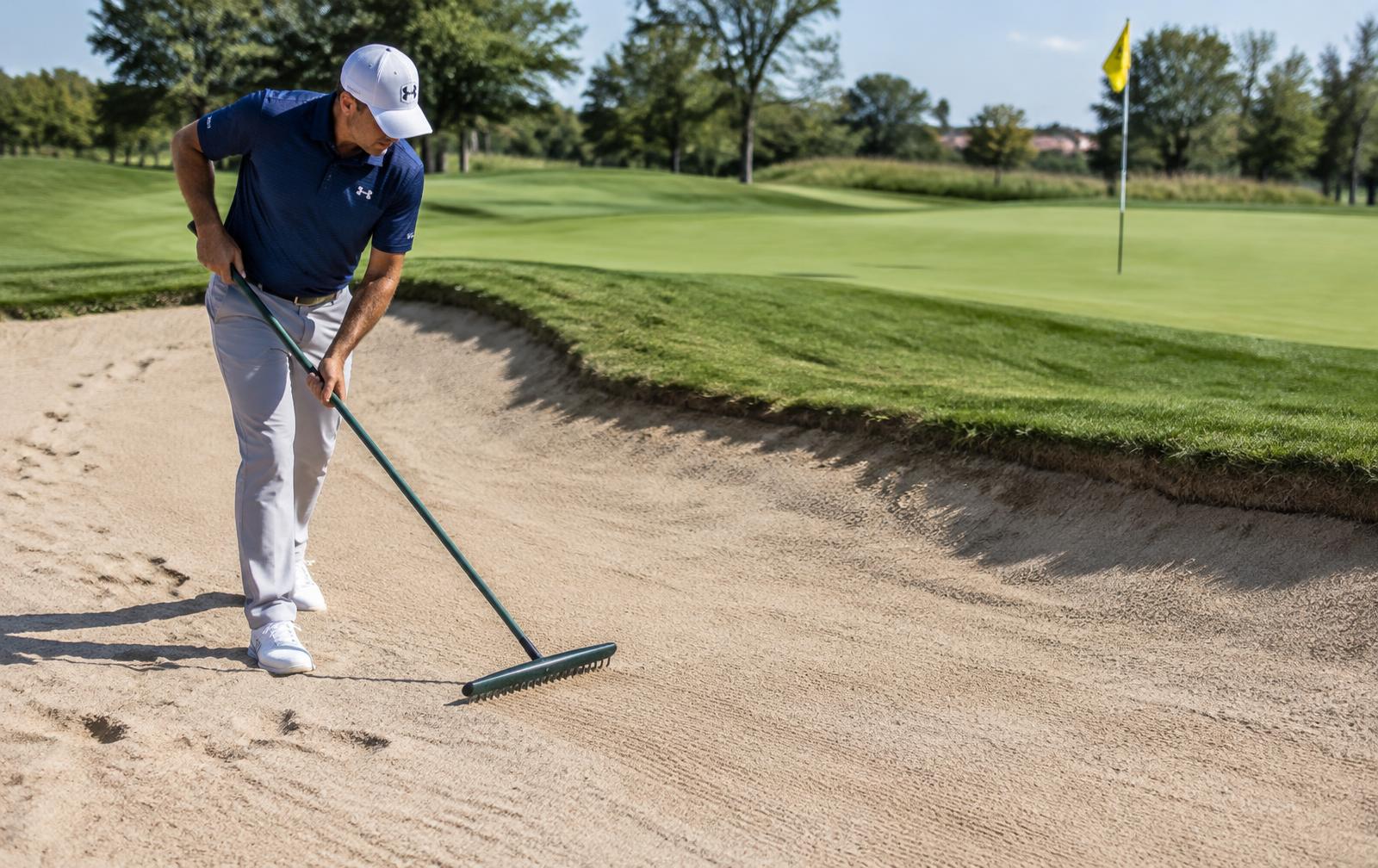
After you play from a bunker (sand trap), smooth over your footprints and the marks left by your club with the rake. Enter from the lowest point, closest to your ball, and leave the rake where the course asks, usually outside the bunker.
11. Respect the green
The green is the most delicate part of the course, so treat it gently:
- Lift your feet when you walk. Don't drag them.
- Don't step on the line between another player's ball and the hole.
- Use a small marker (a coin works) to mark your ball if it's in someone's way.
- Put the flagstick down carefully. Don't throw it.
- Leave your bag or trolley off the green.
12. Use buggies carefully
Follow any signs and keep the buggy away from greens and tee boxes. When the course allows it, TGW recommends the 90-degree rule: stay on the cart path until you're level with your ball, then cut across at a right angle.
The rule underneath all the rules
Golf.com's advice for beginners starts with one line: no one cares how you play. Most golfers are far too busy thinking about their own swing.

A few things that go a long way:
- Say "nice shot" when someone hits a good one.
- Help look for a lost ball for a minute or so.
- Shake hands at the end of the round.
- Tell your group early on that you're new. It tends to relax everyone.
What to do if you get it wrong
You will. Everyone does. Here's how to handle the common slip-ups:
- You talked while someone was hitting. A quiet "sorry" is enough.
- You forgot to rake or repair something. Go back if it's close, or do it next time.
- You're holding up play. Pick up your ball, move on and catch up.
- You hit someone near you. Check they're alright, apologise sincerely and let the group know you'll be careful next time.
Etiquette is about showing care for other people. Nobody will mind a mistake made with good intent.
Finding playing partners who make it easier
Playing with golfers at a similar level is one of the easiest ways to feel comfortable, because everyone is learning the same things at the same pace. We wrote about why playing with players at your level changes everything.
If you're just getting started, our complete beginner's guide to starting golf walks you through the basics, from your first lesson to building a practice plan.
Teewise is being built to match golfers by handicap, age, location and availability, and to include etiquette badges such as Fast Play, so you can see which partners look after the pace of play.
FAQ
What is the most important golf etiquette rule for beginners?
Safety comes first: stand well away from anyone swinging, and shout "Fore!" if your ball is heading towards people. After that, keep up with the group in front and stay quiet while others are hitting.
Is it okay to be slow as a beginner?
Of course, everyone starts somewhere. The key is to be efficient. Plan your shot while others hit, play ready golf, limit your practice swings, and pick up your ball if a hole is going badly in a casual round.
What should I wear for my first round?
It depends on the course, so check the club's website or ask the pro shop. A collared shirt, smart shorts or trousers and comfortable golf or flat shoes are accepted nearly everywhere. Some courses restrict jeans and t-shirts.
What if I hit a bad shot or lose my ball?
Don't worry, it happens to every golfer. Keep your reaction calm, spend a short time searching, and wave through any group waiting behind you. Then drop another ball and keep going.
How do I find people to play with as a beginner?
Ask friends or colleagues who play, look for beginner sessions at local clubs and ranges, or find a partner at a similar level. Playing with people who are also learning takes pressure off.
Teewise is launching soon
Join the waitlist and be first to find playing partners at your level.
Sign up to be the first to know